Direct mail and digital marketing are more powerful together than apart. Most businesses still run them as separate silos — one team handles mailers, another manages ads and email — and the result is disconnected messaging, wasted budget, and low ROI. The fix is integration: aligning both channels into one coordinated strategy where each touchpoint reinforces the next. When done right, this multi-channel approach drives higher engagement, better conversions, and measurable returns.
What Is Direct Mail and Digital Marketing Integration?
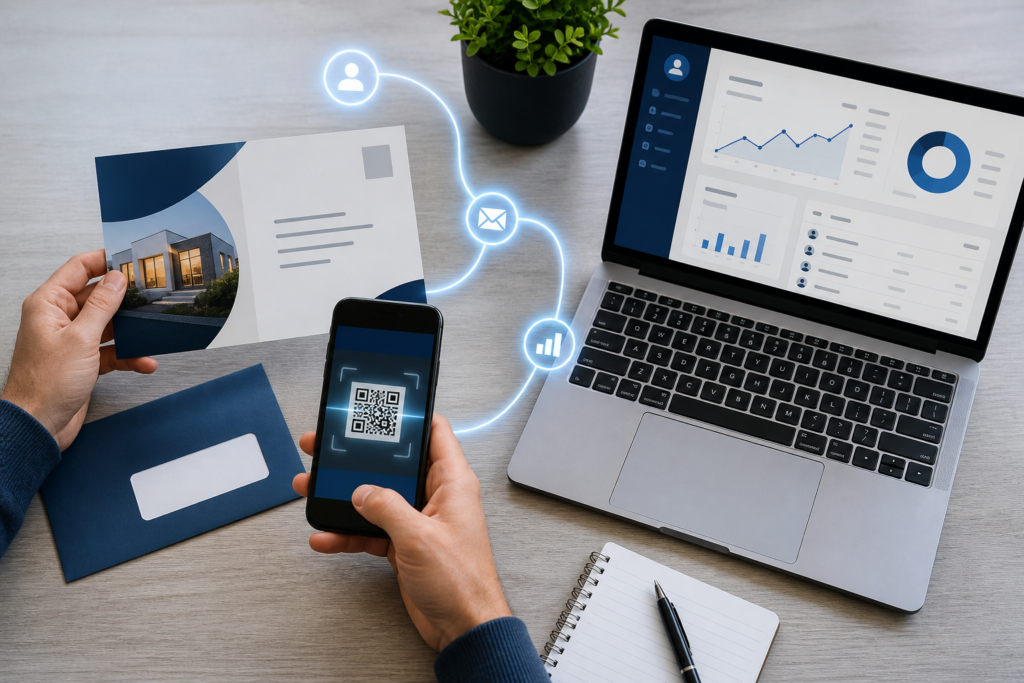
Direct mail and digital marketing integration means combining offline mail campaigns with online channels — email, paid ads, social media, and landing pages — into a single, unified strategy. Instead of treating a postcard as a one-time touch, you connect it to a digital journey. A mailer goes out, the recipient scans a QR code, lands on a targeted page, and gets followed up via email or retargeting ads. Every channel feeds the other.
Why Combining Offline and Online Marketing Works
Physical mail gets attention that digital alone can’t — it’s tangible, it stays on desks, and it has zero inbox competition. Digital channels offer speed, tracking, and personalization at scale. Together, they create a multi-touchpoint strategy that improves recall and drives action. Studies consistently show that campaigns using both channels outperform single-channel efforts in conversion rates and brand recall.
Key Lead Generation Strategies Using Direct Mail and Digital
Strong lead generation strategies use each channel’s strengths deliberately:
- QR codes on mailers — Drive recipients to a specific landing page, making offline-to-online tracking seamless
- Personalized URLs (PURLs) — Give each recipient a unique URL that pre-fills their info and personalizes the page experience
- Email follow-ups — Send a digital follow-up 2–3 days after the mailer lands, referencing the physical piece to reinforce the message
- Retargeting ads — Upload your mailing list to Google or Meta and serve ads to the same audience who received your mailer
This layered approach keeps your brand visible across multiple touchpoints without doubling your message — it amplifies it.
How Targeted Marketing Campaigns Improve Results
Generic campaigns waste spend. Targeted marketing campaigns — built on audience segmentation and behavioral data — ensure the right message reaches the right person. Segment your list by purchase history, geography, job title, or intent signals. Then personalize both the mailer copy and the digital follow-up accordingly.
For example, a printing company can send one mailer to retail clients featuring signage solutions and a different version to event planners highlighting banners and display kits. Paired with matching digital ads, this relevance lifts response rates significantly.
Role of Direct Mail Automation in Modern Marketing
Manual mail campaigns don’t scale. Direct mail automation solves this by triggering physical mailers based on CRM actions — a new lead, an abandoned cart, a lapsed customer, a contract renewal date. Platforms like Lob, PostcardMania, or Zapier-integrated tools can connect your CRM to a print-and-mail workflow, so the right piece goes out at the right moment without manual intervention. This makes campaigns both scalable and timely, which is where the real efficiency gains are.
Best Practices to Improve Marketing ROI
To improve marketing ROI from integrated campaigns:
- Track everything — Use unique URLs, QR codes, and promo codes to attribute conversions to specific mailers
- A/B test creatives — Test headlines, CTAs, and offers across both mail and digital versions
Maintain consistent branding — Same colors, tone, and offer across mail and digital or you dilute trust - Optimize cadence — Don’t flood; a mailer followed by 1–2 digital touchpoints within 7 days is typically the sweet spot
- Review and iterate — Analyze response rates by segment and cut what isn’t working each cycle
Common Mistakes in Digital Marketing Integration
Poor digital marketing integration usually comes down to a few recurring errors:
- Disconnected messaging — Mailer says one thing, the landing page says another
- No audience targeting — Blasting the same piece to your entire list regardless of relevance
- Ignoring analytics — Running campaigns without tracking which channel drove the conversion
- Skipping automation — Relying on manual processes that delay follow-ups and break the funnel
Fix these and your integrated campaigns will outperform almost every single-channel effort you’ve run.
Conclusion
The businesses winning on marketing ROI aren’t choosing between direct mail and digital marketing — they’re using both. An integrated strategy turns one-time touches into full conversion journeys. Start with a single campaign, connect your channels, track the data, and optimize from there. The ROI is in the integration.
Frequently Asked Questions
Q1: What is integrated direct mail and digital marketing?
It’s a strategy that connects physical mail campaigns with digital channels like email, ads, and landing pages to create a unified customer journey.
Q2: Does combining direct mail and digital improve ROI?
Yes. Multi-channel campaigns consistently show higher conversion rates and better ROI than single-channel approaches.
Q3. How do QR codes help in direct mail campaigns?
QR codes bridge offline and online by sending mail recipients directly to a tracked landing page, making response measurement easy.
Q4. What are PURLs in direct mail?
Personalized URLs are unique web addresses assigned to each recipient, allowing personalized landing pages and individual-level tracking.
Q5. What tools support direct mail automation?
Platforms like Lob, PostcardMania, and Sendoso integrate with CRMs to automate triggered mail campaigns.